
Ever thought one workout could make you stronger all over? Try this kettlebell routine that guides you through seven smart moves. Each move works your muscles, strengthens your core (the middle part of your body), and even tests your grip. The exercises move smoothly from one to the next, keeping your heart pumping and your body active.
Do three rounds with a short break between each round. Soon, you’ll feel more power and balance in your everyday life. Give it a go and see the strength build with every swing.
kettlebell strength training workout: Build Massive Strength
This kettlebell workout challenges you from head to toe with seven different exercises. It builds muscle strength, boosts your core stability (keeping your balance steady), and improves your grip thanks to a unique weight design. You move from one exercise to the next without resting, which raises your heart rate and builds strength at the same time. Aim for three rounds each session with 1–2 minutes of rest between rounds and try to do this up to three times a week.
| Exercise | Sets | Reps | Rest |
|---|---|---|---|
| Kettlebell Goblet Squat | 3 | 10-12 | 1-2 min after round |
| Split-Stance Row | 3 | 8-10 per side | 1-2 min after round |
| Strict Press | 3 | 8 per side | 1-2 min after round |
| Chest-Loaded Swing | 3 | 15 | 1-2 min after round |
| Shoulder Halo | 3 | 8 each direction | 1-2 min after round |
| Hip Pass | 3 | 8 per side | 1-2 min after round |
| Figure-8 | 3 | 5 each direction | 1-2 min after round |
This workout flows naturally from one move to the next, engaging several muscle groups at once. Every exercise challenges your grip while also keeping your core on duty for balance. The short 1–2 minute rest between rounds gives your muscles a quick break so you can keep the intensity up. With regular practice, you'll boost your strength and overall fitness in a safe and effective way.
Progression Strategies for your kettlebell strength training workout
Start by using the Rate of Perceived Exertion (RPE) scale. Rate your effort from 1 to 10. If your workout feels like a 5 or 6, try slowing your pace, pausing at the tough part of the lift, or adding an extra set. For example, if the kettlebell feels too light, add a deliberate pause mid-rep to keep your muscles working hard.
If you're ready to step up your workout, try drills like the single-kettlebell halo or the Turkish getup. These moves help improve your balance and shoulder stability while refining your technique. When you feel comfortable and want more challenge, consider using a heavier kettlebell (about 53 lb or 24 kg) while keeping your form solid.
Plan your session by warming up your body first with some light activation to wake up your central nervous system. Next, do focused strength sets. Finish with a conditioning move, like high-rep swings or dynamic exercises. This layered approach helps you maintain good form and steadily build strength.
Fundamental kettlebell strength training workout Movements
Hinge Movement
Begin with a kettlebell deadlift. Stand with your feet hip-width apart and place the weight between your feet. Hinge at your hips, keep your back flat and tummy tight. Push through your heels and squeeze your glutes at the top. Aim for 3–4 sets of 6–10 reps, focusing on smooth moves and proper foot alignment.
Squat Movement
For the goblet squat, hold the kettlebell close to your chest with both hands. Keep your elbows tucked and your chest raised. Lower yourself by bending your knees and pushing your hips back slowly. Remember to breathe steadily. Try for 3–4 sets of 6–10 reps with deep, controlled squats that work your quads and glutes.
Pull Movement
Do a single-arm supported row by placing one hand on a stable surface for balance. Hold the kettlebell firmly in your other hand. Keep your torso parallel to the floor and pull the weight toward your side by driving your elbow back. Complete 3–4 sets of 6–10 reps on each side, while keeping your spine neutral and core engaged.
Press Movement
For the single-arm military press, start in a rack position with the kettlebell close to your body. With a neutral wrist and tight core, press the weight overhead slowly. Focus on fully extending your arm at the top and keeping your shoulder stable. Work each arm for 3–4 sets of 6–10 reps.
Carries
Practice different carries by simply walking while holding the kettlebell. Whether you try a farmer’s, suitcase, or overhead carry, stand tall with your shoulders back and core tight. Walk steadily for a set distance or time, maintaining proper joint alignment and controlled breathing. Perform 3–4 sets for each variation.
Incorporating ballistic drills in your kettlebell strength training workout
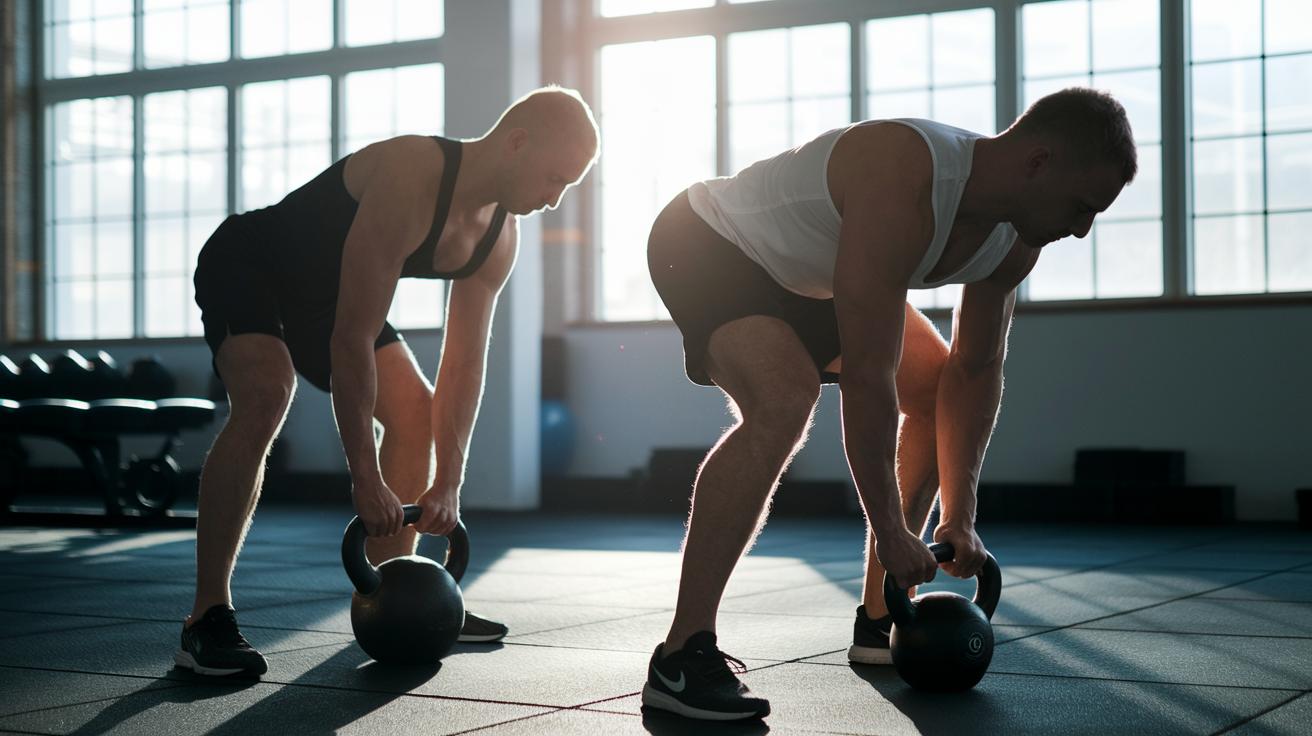
These ballistic drills can give your kettlebell routine a burst of power while boosting strength and upping your calorie burn. They help you build strong hip drive, improve one-sided strength (unilateral power), and smooth out your timing and coordination. Start adding these moves one at a time and notice how each motion becomes stronger and more fluid.
- Two-Handed Kettlebell Swing – Do 3 sets of 10 to 15 swings. This drill fires up your hips and works the muscles along the back of your body.
- Single-Arm Swing – Do 3 sets of 10 swings on each side. This move challenges your balance and builds strength on one side at a time.
- Kettlebell Clean – Do 3 sets of 8 to 10 reps on each arm. Transition the kettlebell smoothly from a swing into a steady, rack-like hold.
- Kettlebell Snatch – Do 3 sets of 6 to 8 reps on each arm. Begin with a press and then move the weight between your legs to finish with a locked overhead position.
Moving from the basic swing to the more advanced snatch keeps challenging your muscles. With each drill, you build more explosive power and a more efficient movement pattern. Try adding one new drill during your next workout and feel the difference in energy and strength.
Safety Guidelines for your kettlebell strength training workout
Keep your wrists straight, secure your elbows under the bell, and hold your back in a straight line. This basic alignment protects your joints and keeps your form strong, much like a solid building foundation, every rep really counts.
Begin with a warmup that wakes up your muscles. Try a straight-leg hip circle to loosen your hips, a hip-opening mountain climber to activate your core, a sky reach to arm thread to stretch your shoulders and upper back, and an arm screw to boost shoulder circulation. These drills get your blood flowing and make your workout safer and more effective.
If you find your shoulders are tight or the kettlebell feels too heavy, switch the overhead press with a one-arm floor press. This small change stops you from fully locking out your shoulder and keeps strain to a minimum, helping you build strength safely.
Designing a Periodized kettlebell strength training workout Plan
Begin by checking in with your body using the RPE scale (1–10). When your workout feels like an 8, try lowering the reps or intensity next time so your muscles have time to recover. Think of this scale as a speedometer for your effort, if you're pushing too hard, it might be time to ease off a bit.
Match your workout cycles with a simple nutrition tracking routine. Use an app to keep an eye on your protein and calorie intake. For example, during a winter bulk period, you might plan slightly higher volume workouts and adjust your nutrition to help build mass. This way, your body gets the fuel it needs to bounce back after tough training sessions.
Set up your plan in cycles that last about 4–6 weeks. Aim for three sessions per week, making sure to leave a day in between for adequate recovery. This structured approach builds strength steadily and keeps you on track. Try making small tweaks each cycle and let the RPE scale be your guide along the way.
Advanced Techniques for kettlebell strength training workout
Turkish Getup
Start by lying on your back with one arm holding the kettlebell high toward the ceiling. Roll onto your side and use your free arm to help bring your body into a half-kneeling stance. Press the weight upward while keeping your core tight and your balance steady. Then, gently shift your weight forward to stand up, always holding the kettlebell securely. Reverse the steps slowly to return to your starting position. Aim for 4-6 reps on each side, focusing on smooth, controlled moves and even breathing.
Single-Kettlebell Halo
Hold the kettlebell by the handle with both hands. Slowly move the bell around your head in a full circle, switching your grip as needed. Keep your core firm and let your shoulders relax to support the movement. Try to do 8 halos in one direction, then switch to the other. Keep your head lined up with your spine so you avoid any extra strain.
Conditioning Finisher
End your workout with a burst of energy using ladder-style swings. Pick a kettlebell that fits your level, experienced folks often go with a 24 kg weight (about 53 lbs). Swing the bell continuously for 60 seconds, then rest for 30 seconds. Repeat this cycle for 5 rounds. Focus on using a strong hip drive and steady breathing throughout to maintain great form and work your muscles safely.
Final Words
In the action, this guide walks through setting up a kettlebell strength training workout that builds muscle, enhances core stability, and improves grip strength. We covered full-body circuits with specific exercises, progression checks, solid movement mechanics, and ballistic drills to boost power. Safety guidelines and a periodized plan help you move forward confidently. Advanced techniques offer extra challenge as you grow stronger. Small, sustainable changes here can lead to big wins for your mindset and body. Keep at it, you’re doing great!
FAQ
What do kettlebell workout PDFs offer?
The kettlebell PDF resources present detailed routines for both full-body and upper-body strength training at home. They include clear illustrations, set and rep guidelines, and safety tips to help you build strength effectively.
Can you strength train with just kettlebells?
Yes, you can strength train solely with kettlebells by using various exercises that target major muscle groups like squats, swings, and presses. This approach promotes muscle gain, core stability, and improved grip strength.
What will 100 kettlebell swings a day do?
Performing 100 kettlebell swings daily increases cardiovascular endurance, builds lower body and core strength, and boosts grip power, enhancing overall fitness when combined with a balanced training routine.
Can you build muscle with kettlebell training?
Kettlebell training builds muscle by engaging several muscle groups with dynamic movements such as swings, presses, and squats. Using proper form ensures effective strength gains and overall muscle development.
Is a 20 minute kettlebell workout enough?
A 20 minute kettlebell workout can be enough when it’s structured as an intense circuit that targets major muscle groups. Short, focused sessions help boost strength and endurance even with limited time.
What is the kettlebell Turkish get-up lunge style?
The kettlebell Turkish get-up lunge style combines the stabilization of a Turkish get-up with a lunge movement. This variation challenges balance and leg strength while providing effective lower-body and core engagement.
What is the kettlebell windmill exercise?
The kettlebell windmill exercise focuses on the core, shoulders, and hips by bending sideways while keeping the kettlebell fixed overhead. It helps improve flexibility and stability with controlled, precise movements.
What is a kettlebell halo?
The kettlebell halo involves circling the kettlebell around your head to engage shoulder stabilizers and core muscles. This exercise enhances joint mobility and upper-body strength with consistent, smooth motions.
How is a double kettlebell push press performed?
The double kettlebell push press uses a slight hip drive to propel two kettlebells overhead. It builds upper body strength, engages the core, and challenges balance while emphasizing a controlled press lockout.
What is a kettlebell goblet squat?
The kettlebell goblet squat requires holding the kettlebell close to your chest while performing a squat. This movement effectively targets the quads, glutes, and core, building lower-body strength and stability with each rep.
What is a kettlebell thruster?
The kettlebell thruster combines a squat with an overhead press, engaging both lower and upper body muscles. This dynamic exercise boosts power, endurance, and metabolic rate, making it an efficient full-body strength move.